Customer's savings per year:
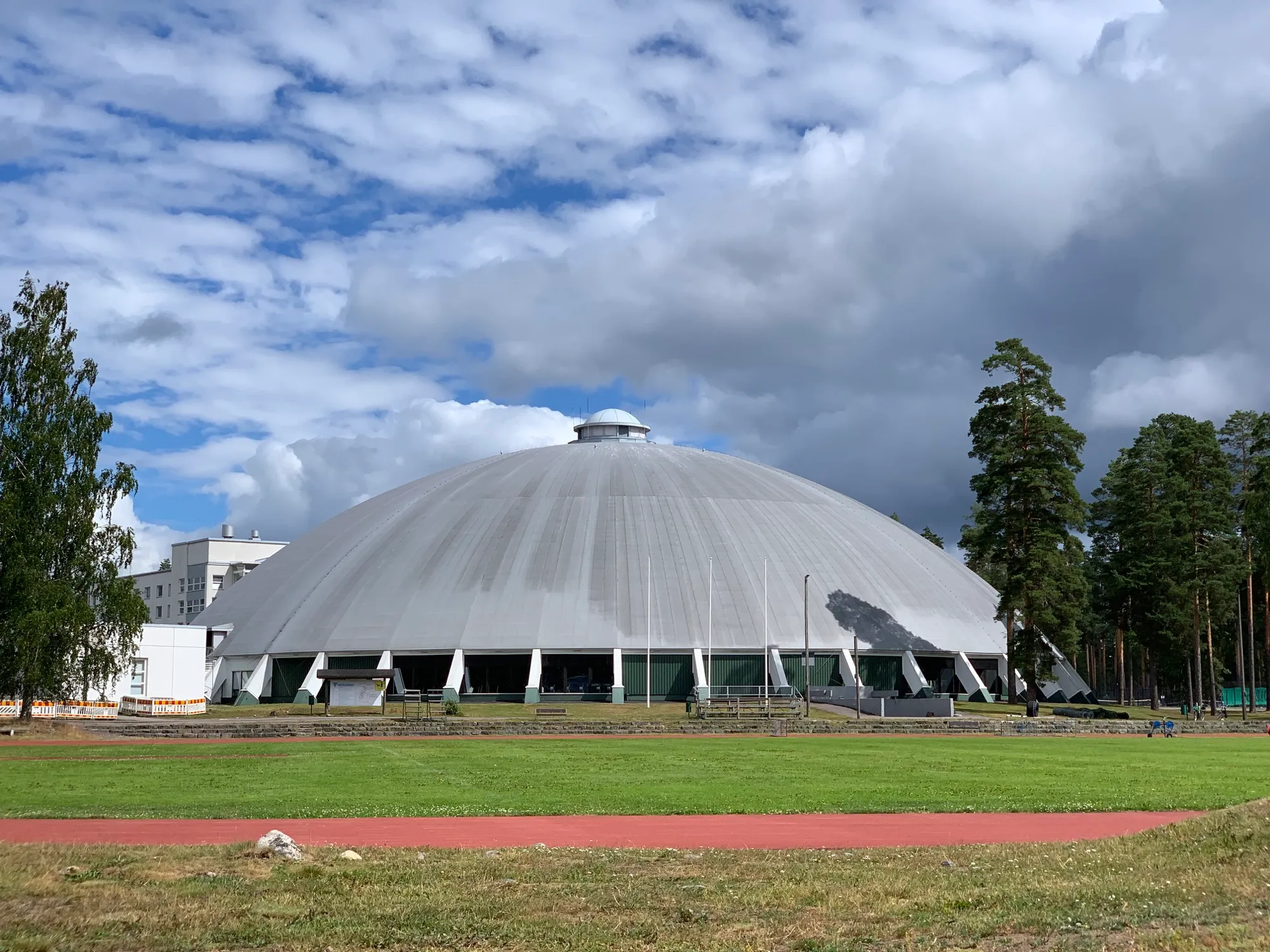
Vierumäki is one of Finland's best-known sports and wellness centres. The site is actively used year-round, and visitor numbers vary according to sports camps, events and seasons.
The restaurants Puhti and V, located alongside Hotel Fennada, serve breakfast, lunch, dinner and supper, and kitchen use varies hour by hour.
In this kind of environment, controlling restaurant kitchen ventilation with a traditional time schedule is a compromise between indoor air quality and energy efficiency: if ventilation is sized for peak demand, energy is wasted for much of the time; if it is sized to the average, there is a risk of deteriorating working conditions for the kitchen staff.
Vierumäki decided to invest in a solution where ventilation reacts to actual use, so the kitchen gets good conditions as energy-efficiently as possible.
The solution: sensor-driven ventilation that follows kitchen use
The Finnish-made Safera FlowHero demand control kitchen ventilation system measures the load on different kitchen workstations with sensors. The sensors send data to the FlowHero HUB unit, which combines the measurement results into a single 0–10 V ventilation control signal that represents the ventilation demand.
The control signal is connected to the building automation, which, based on the signal, adjusts the supply and exhaust fans of the hoods steplessly between the design and minimum airflow rate, or switches the fans off entirely when needed.
The solution is a one-time investment that operates as a permanent part of the building services. In addition, customers have access to comprehensive analytics services for the measurement data, which were also used at Vierumäki to optimise energy savings.
Controlled commissioning by leveraging automation trend data
Commissioning of FlowHero at Vierumäki proceeded in stages.
First, the system was installed in one evening after the restaurant had closed, without affecting kitchen operations. After that, FlowHero began monitoring kitchen use and conditions while the ventilation was still running on the timer control. The monitoring captured a comparison period of air quality data, which was later used to verify that the energy savings were not achieved at the expense of conditions when demand control was finally connected to the automation.
During commissioning, the control signal was compared against the automation's trend curves for several weeks, to ensure that ventilation reacted to the load correctly and stayed within the design values.
Already at an early stage it was observed that the energy saving potential matched well with Safera's pre-project estimate, because the ventilation was running at high capacity also when there was no actual load.
Data revealed further optimisation without new equipment investments
One of the air-handling units at the Vierumäki restaurant property has one supply fan and two exhaust fans. The FlowHero system was designed from the start so that the exhaust fans could be controlled either together or separately.
At first, the fans were controlled uniformly to ensure the ventilation balance. During the interim review, however, the data showed a clear difference: the load on one exhaust fan was concentrated in the morning and at lunch, and the other in the evening. The observation from the data also matched the actual operation of the restaurants in the same kitchen space.
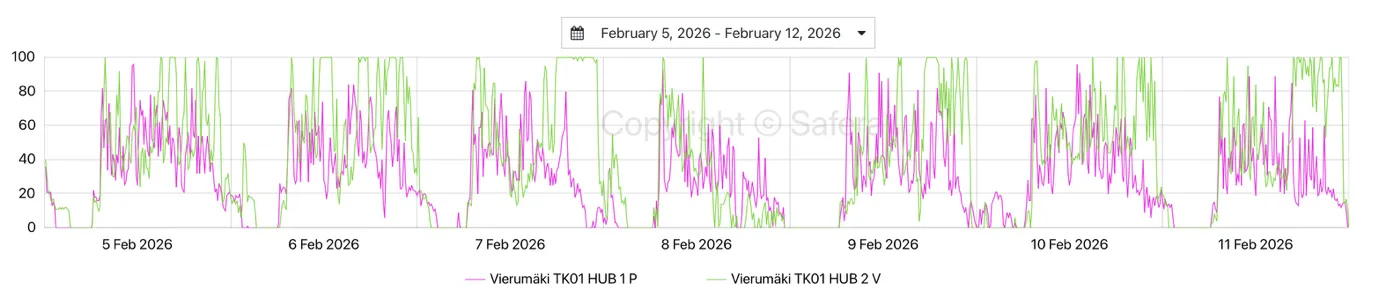
The automation was updated so that the exhaust fans started to be controlled in a managed way according to their own area of influence. The change is estimated to bring a further 10–20 % saving without new equipment investments.
Measurable results
From autumn 2025 onward, the restaurant property's total electricity consumption was approximately 7 MWh per month lower compared to previous years. No other significant technical changes were made at the property at the same time as the introduction of demand control.
The annual savings in heating and electricity consumption produced by demand control were calculated from the control trends of the fans. Already before further optimisation, the annual results were:
- 87 MWh energy saving
- 11.7 tCO₂ reduction
- €7,800 cost savings
- 2.5 years payback time
At Vierumäki, the results show in the property's energy consumption, operating costs and carbon footprint.
FlowHero enables a model of continuous improvement
FlowHero controls ventilation automatically and produces energy savings by adapting ventilation to the actual use of the space as a part of the HVAC and building services. In addition to the concrete energy saving, Vierumäki makes use of the data recorded by FlowHero along with Safera's analytics service, with which the operation of the system is monitored and continuously improved.
Safera's Chief Growth Officer Henri Andell has been Vierumäki's account manager from the beginning and considers the customer a good example of what the FlowHero system can do:
"What happened here is that one of my favourite holiday destinations in my free time is now also one of my favourite customers in my working life. Vierumäki is very committed to improving energy efficiency. Cooperation has been open, professional and smooth throughout. They also already had comprehensive monitoring in place for the properties' energy consumption and conditions, which FlowHero now complements on the kitchen side."
At Vierumäki, energy efficiency is managed like an athletic performance: by measuring, analysing and improving. FlowHero demand control is a natural part of long-term, results-driven energy efficiency work.
Request an energy saving estimate for your property
Contact us, and we'll calculate how much FlowHero can also help your property save energy and reduce carbon emissions.
Download the latest case studies
Download the latest case studies and see how we help our customers to reach their sustainability goals.